

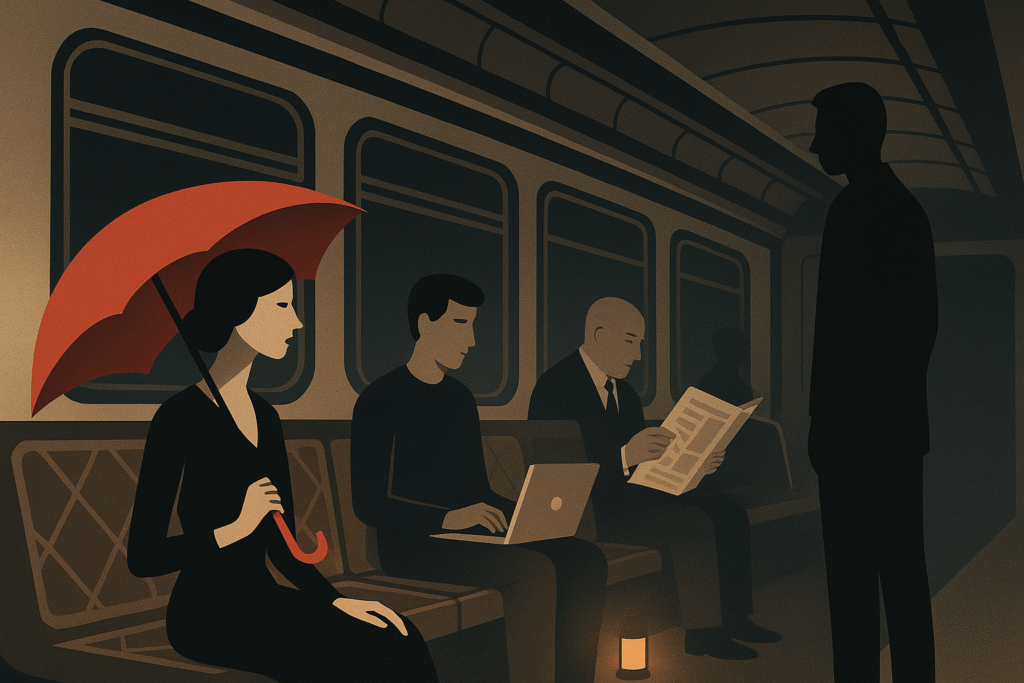
The last train into the city at that hour was a rumor wrapped in old fluorescent lights and the metallic sigh of brakes. It ran late and seldom; it whispered of cheaper rents and midnight shifts and the kind of people who kept their own small secrets tucked into the seams of their jackets.
Arjun nearly missed it. He had been at the office longer than he’d meant to, fingers black with code and a stomach that protested bland noodles. He sprinted down the tiled steps, the station echoing with a slow, damp breath, and found the last car with a cracked poster for a concert three months past. Only a few passengers sat in the windows’ pool of light: a woman with a red umbrella, a student with an open laptop, an old man with a folded newspaper. The carriage smelled like metal and mint gum.
He took a seat opposite the umbrella, put his bag on his knees, and closed his eyes for the ride. The train swayed, a gentle lullaby. The city blurred outside into anonymous streaks.
When Arjun opened his eyes, everything felt… late. The lights hummed the same, the rails clicked in the same rhythm, but the carriage had a quality you don’t notice until it becomes the only thing you can notice: absolute stillness. Not the kind of quiet that waits for someone to speak, but the kind of stillness you get when a camera’s shutter holds on a single frame.
The old man had not lowered his paper. The woman’s umbrella hovered a finger-length from the floor as if caught by a frozen draft. A drop of water — a bead that had been sliding down the red umbrella — hung in the air, round and perfect.
Arjun blinked twice. The student’s fingers hovered above the keyboard like a pianist mid-note. The fluorescent light hummed but its filament looked like a narrow white rod, unmoving.
“Hello?” he said, and the word swallowed itself.
The train only answered with the soft mechanical whisper of the tracks. He stood up. The shoes of the old man were planted like fixtures. He reached out and touched the newspaper. It did not rustle; his fingers met its roughness and the paper was cool as if printed minutes ago.
Panic, soft and electric, pulled at him. He checked his phone. No service. The screen showed the lock screen but the clock had stopped at 12:07 a.m. as if time had taken a breath at that exact minute and decided not to continue.
Arjun moved through the carriage like a man in a pool. Each step was a decision against a gravity that was suddenly moral as well as physical. He touched the student’s wrist. The skin was warm under his fingers, alive. A bead of water on the umbrella trembled minutely, then, impossibly, fell — but instead of splatting, it hung for one long heartbeat then rose back up and dotted the fabric like a star. Arjun staggered.
There was something else: the faint sound of music. He couldn’t find the source. It was thin at first, a single clarinet note, then a rawer line that braided with a laugh — a child’s laugh. The laugh came from the end of the carriage. He walked until the light grew colder.
At the far door stood a woman in a uniform like a conductor’s, though she did not belong to any line Arjun recognized. Her coat was dark, and her badge had no number. She held a small lantern that cast more shadow than light. Her face was a map of small, patient distances. She looked up at him as if she’d been waiting for him to arrive.
“You’re late,” she said.
“I… what happened? Why is everyone—”
“Frozen,” she answered. “Paused. Sometimes the metro does that. Sometimes it chooses a passenger to sit with the paused until they understand.”
“Chooses? Chooses what?” His voice hit the stillness and fizzed out.
The conductor’s eyes were neither kind nor cruel. They were exact. “A passenger to learn,” she said. “You have been chosen.”
He thought it was a joke at first. A prank with an elaborate stage. But the conductor did not smile. The lantern’s light trembled, showing thin lines on her face.
“You made someone stop,” she said, pressing the weight of it into a syllable. “You were there.”
The phrase landed like a pebble. He remembered a night — three months ago, the city slept in a different economy of light. He had been driving, a brief lapse, drink and impatience; there had been a pedestrian — a man crossing in the wrong glow. A screech. A bruise of sound. He had driven on. He had told himself later that he had called the police, that someone had found the man, that he’d given a statement in a voice that was clear and useful when examined. He had told himself the truth he could live with. He had not told the deeper truth: his own fear had had a weight to it. He had feared the long troubles that follow a bad night.
The conductor watched his face. “You are here to see what that choice made.”
Arjun’s stomach folded. He wanted to deny it, to say some neat thing about a mistaken identity, about memory. But his pulse sang a treacherous honesty. He remembered, with the sting of damp glass, the man’s face — not distinct, but enough. He could have stopped.
“Why me?” he said. “You can’t—”
The carriage shivered as if the train itself had sucked in air. The paused passengers arranged themselves in a tableau of small truths. The old man with the paper had a small bandage at his temple — Arjun remembered now that he’d been seen by the light of a hospital, perhaps. The student’s laptop was open to a photograph of a woman with a toothy grin. The umbrella woman’s fingers were scarred like someone who mended nets.
“You can walk out the door right now,” the conductor said. “You can choose to go, and never know the exact shape of what stays behind. Or you can stay, see what is paused, and perhaps make a repair.”
Repairs were not things Arjun had learned. He had debugged software until dawn, rewritten logic, but not rewoven a life. He thought of the man on the road. He thought of the soft, accusing rhythm of his own avoidance.
He sat down because he had no other option. The conductor sat opposite him and set the lantern between them. The light made small islands on the vinyl seats.
“Listen,” she said. “The metro pauses small things when the city cannot notice them. It pauses a slice of time so someone might look. Often, it wants to see if the person chosen will act. Sometimes the test is simple: give back a wallet, call a number. Sometimes it is not.”
“How do I know what to do?” He found the question embarrassing in its helplessness.
“You know,” the conductor said. “But you have to look without looking away.”
He moved among the still bodies like a man fumbling through an abandoned house. He found the student’s photo: a father and son at a fair. He found the folded map in the umbrella woman’s handbag. He found small artifacts like bread crumbs and a receipt. Each item was a shard of a life. When his hand brushed the old man’s paper, the headline shifted in a way that could have been a whisper: Missing: one. But headlines did not move. Only something in the air moved — a suggestion that the paused had stories that waited like hands under cloth.
At the window, the city trainsleeped on. Outside, lights went on and off in buildings like a slow Morse. A homeless man outside the carriage had a sleeping child on his lap. Arjun’s throat tightened. He had seen that child months ago in a crosswalk in a haze of hazard lights and not stopped. He had been, more and more clearly, one of those who turned away when a moment demanded the opposite.
He lifted his head, and the conductor produced a coin from her pocket as if retrieving caution from an old person’s change jar. “Pick one,” she said. “A memory. Touch it. Tell the truth for it.”
He hesitated, then took the coin. It was cold and heavy with a history he couldn’t name. When he closed his fingers around it, a vision slid over his inner sight like a translucent film: the street three months ago, the pedestrian’s face, the glitter of a phone screen, the way the rain had shone on the asphalt like a plate. He saw himself speeding away, headlights receding like a pair of closing eyes.
Telling the truth — that was the trick. The conductor didn’t demand a confession to a courtroom or a police report. She demanded honest light. Not the legal truth with its paper and signatures, but the kind of truth that unclenched your chest.
Arjun swallowed. The carriage seemed to inhale. He put his hand on his heart and spoke.
“I didn’t stop,” he said. The words were small, but the train took them like a bell. “I was afraid. I left. I told myself later that I had done what I could, but I didn’t. I thought of consequences, of trouble. I thought of my life.”
He expected nothing and got everything. The student’s fingers uncurled, then moved a fraction. A breath left the umbrella woman. The bead on the umbrella slid and fell, then splashed onto the fabric.
The conductor’s lantern brightened as if someone had turned up the dimmer of the world. “Confession alone is not repair,” she said. “Repair is action.”
“What action?” Arjun asked.
“You can call,” she said. “You can find the paused one and do what you did not. You can be the person you should have been. The metro gives you the rest of the night to make one right thing.”
The choice felt both merciful and cruel. There was a limit to making amends. One act would not unmake weeks, but perhaps it could bend a branch back to a straighter course.
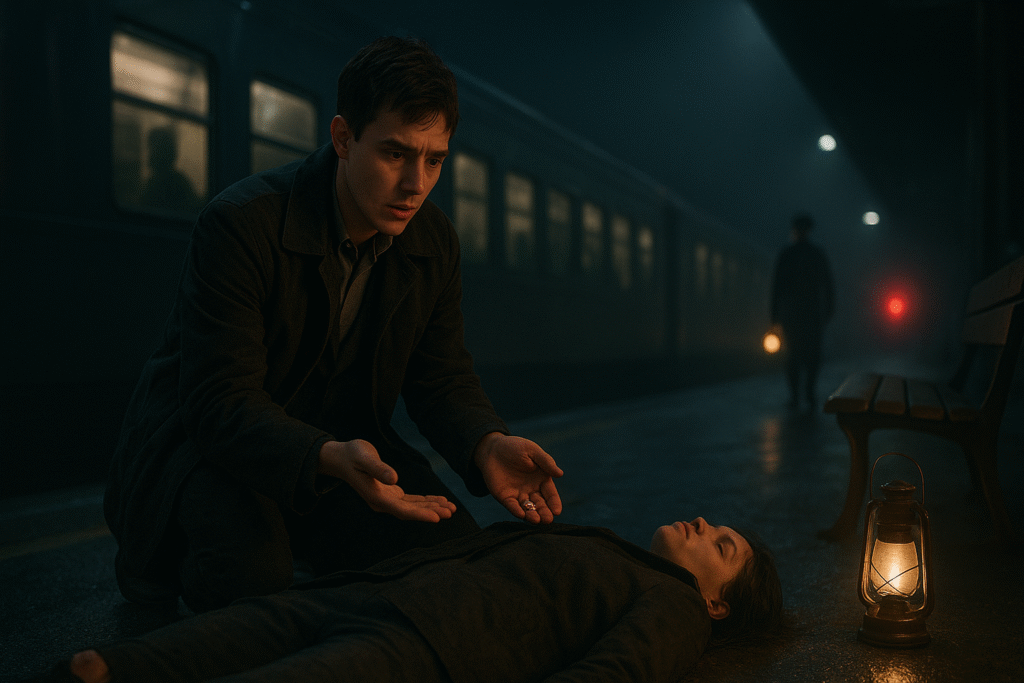
The conductor pointed to the end of the car where a small door led to the platform. Arjun stepped off the train and the air felt like a slap — colder, sharper. The platform was empty but for a single figure curled in the shadow near the far exit: a man with scraped knees and a jacket too thin for the season. Up close, the man was unmistakably the one from the memory — older, perhaps, worn like an old shirt, but the same face under the grime.
Arjun’s knees went soft. He knelt beside him, mind flooding with apologies he had not believed himself worthy of. He checked for breathing, for pulse. The man’s chest rose, small and steady. He was alive. Around them, the station’s light felt ordinary again, normal even.
“I called the ambulance,” Arjun told him, words tumbling out like things thrown overboard. “I told them where you were. I stayed. I was here.”
The man opened his eyes. They were not accusatory. They were honest in a way that embarrassed Arjun.
“You are the one who drove past,” the man said, voice a roughened thing. “I thought— I thought I’d be alone.”
“You can call someone,” Arjun said. He pulled out his phone. For the first time since the train’s clock had frozen, service bars lit the screen. He dialed. Numbers rang. A recorded operator took the details. He stayed with the man until the siren cut the night’s skin and caretakers came to lift the injured into safe hands.
When he returned to the carriage, daylight was not yet a promise, but the paused faces had rearranged into a normal disorder: the student typing, the umbrella woman smoothing her skirt. The conductor had her lantern down now, her expression unreadable.
“You did what you could,” she said.
Arjun wanted a simpler absolution. He wanted a line that would make the calendar scrub his mistake clean. But the conductor only offered a small thing that felt like both a promise and a warning.
“People will still make choices you cannot control,” she said. “You cannot prevent all harm. You can only decide how you stand when the moment asks.”
He nodded. The train began to move, slowly, as if it had been waiting for his choice to settle into him. As they rolled into the stuttering wake of the city, the conductor rose and walked down the car, touching the shoulders of those who had been paused like a seamstress finishing a hem.
When the train pulled into his stop, Arjun shouldered his bag and stepped onto the platform with feet that felt new. Behind him, inside the carriage, the conductor had vanished as if she had never been there. Only the faint glow of the lantern remained for a moment on a seat, then winked out.
Outside, the city was not transformed into a kinder place. Honk and siren would still argue with one another, and strangers would still sometimes look away. But the night held one less cold omission. Arjun walked home through streets that smelled of frying onions and wet tar, and somewhere in his pocket the coin the conductor had given him warmed, like a small sun.
That night he wrote a single line in his phone — not for the police, but for the record he would keep of the person he wanted to be: Tonight I stayed. He put the phone down, and for the first time in a long while, he did not turn away from the sound of his own breathing.
The midnight metro took other people, elsewhere, to ask the same impossible favor. Sometimes it chose the reckless, sometimes the careful, sometimes someone who had been brave all along. It did not judge with the hard lines of law. It was less: a sly, patient machine that stopped the world for a while to ask a human to notice. Sometimes the city consented to be saved.
If you ride the last train and find your carriage frozen like a photograph, don’t panic and don’t be proud. Sit down. Listen. You might be asked to make a small, difficult thing right. It will not erase what was, but it could change what comes after.
And if, as the lights hum and the rails whisper, you hear a child’s laugh from the back of the carriage, maybe — if you have the courage — you will answer.


Alright, so 9556bet1. It’s decent. Nothing that’ll blow your mind, but a solid option if you’re looking for something reliable. Check it at 9556bet1.
E aí, galera! No 77betcasino, encontrei uns slots bem divertidos. O site é fácil de navegar e os bônus são um atrativo. Vale a pena conferir para se divertir um pouco. 77betcasino